Electron and Optical Microscopy Facility
Location: SB-56 Bard Hall, 1149 Snee Hall, 150 & 238 Duffield Hall
Fax: (607) 255-2365
Staff

Co-Facility Manager
SEM, EMPA, Optical
John Hunt
hunt@ccmr.cornell.edu
(607)255-3789, (607)255-0108, cell (607)592-8990

Co-Facility Manager
TEMs
John Grazul
grazul@ccmr.cornell.edu
(607) 592-8989
Prof. David Muller
A&EP
Overview
The Electron and Optical Microscopy Facility provides microscopes for imaging small features and for microanalysis of the elemental composition of materials. Electron microscopy equipment includes a scanning electron microscope (SEM), an electron microprobe (EPMA), a transmission electron microscope (TEM), an energy-filtered TEM (EFTEM), and a high resolution transmission electron microscope/ scanning transmission electron microscope (TEM/STEM) with a high resolution electron energy-loss spectrometer. A variety of optical (visible light) microscopes (OMs) are also available. Digital Imaging is used on all microscopes.
Electron Microscopes
- FEI Tecnai G20 TEM/ STEM
Three-dimensional realization of the tantalum electromigration barrier layer coating a copper interconnect structure. Electromigration leads to the failure of wires in micro-electronics through void creation. The image was reconstructed using electron tomography, a technique similar to the medical CAT scan that differentiates between materials within the depth of a specimen. Construction of this structure requires the deposition of two tantalum thin films and results in surface roughening. This roughening is apparent and quantifiable, and a cut away of the high resolution reconstruction shows the double tantalum thin film structure. Imaged using the CCMR Tecnai by Peter Ercius.200kV Field Emission transmission electron microscope with monochromator. 1 Å in TEM and 1.4 Å in STEM. Equipped with new Gatan Tridium Spectrometer for EELS spectra at high energy resolution <0.2eV, optimized recording of energy filtered TEM elemental maps, EELS low-loss studies (e.g. band gap analysis), and chemical bonding information at nanometer resolution.
- JEOL 1200EX TEM
Octahedral silica nanocages are prepared by a facile one-step approach, which also enabled controlled functionalization with Pt in the cavities. The strategy is based on mediated deposition of silica on simultaneously generated salt quasi-templates, which can be simply removed by washing with water. Imaged using the CCMR JEOL 1200 by David X. LouThis instrument is used for routine TEM observation. It has a single tilt and double tilt holder; resolution is 0.3nm. The 1200 TEM can used for imaging of inorganic materials, biological samples and polymers. Diffraction imaging can also be done. There is a digital camera and computer attached to the scopes well as film. Also available is a high resolution film scanner and analysis software.
- LEICA 440 SEM
Micro-engineered biomineralized materials that will have applications in bone regeneration and dental restoration. The crystals are hydroxyapatite, a major component of bone. Imaged using the CCMR SEM by Dr. Jian Tan (C&BE).Secondary Electron Imaging (SEI) provides 4.5 nm resolution at 30kV. Backscattered Electron Imaging (BEI) provides strong Z contrast. Electron backscattered diffraction (EBSD) allows crystallographic orientations to be determined from micron-sized grains (texture analysis). An EDS X-Ray detector is also available on this microscope.
- JEOL 8900 EPMA Microprobe
SEM image of GaN samples grown using sublimation. Research in progress by graduate students Phanikumar Konkapaka and Huaqiang Wu, who are advised by Prof. Michael Spencer (ECE).Used for quantitative elemental analyses of features as small as 1μm. Five automated Wavelength Dispersive X-Ray Spectrometers (WDS) and one Energy Dispersive X-Ray Spectrometer (EDS). Imaging modes include X-Ray mapping or line profiles, secondary and backscattered electrons. Under favorable circumstances, the minimum detection limit is as low as 30 ppm. Boron is the lightest detectable element. Remote use is possible. Software is available for the analysis of thin films on substrates and particle sizing. The EPMA is located in 1149 Snee Hall.
Capabilities
- Sample Preparation
In addition to the Electron Microscopes, the Facility provides a complete array of TEM sample preparation equipment. This includes Multi-prep tripod polishing, jet polishing, ultramicrotomy, plasma cleaning, a disc cutter, dimpler, and ion mill for making thin TEM specimens, and a Au-Pd sputterer, ion-beam sputterer and an evaporator for coating specimens with conductive films of metal or Carbon. TEM sample preparation equipment is located in 238 Duffield.
- Optical (Visible Light) Microscopes
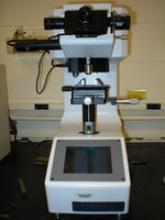
Brightfield, darkfield, polarized light, relected, transmitted, differential interference contrast (DIC), and bright fluorescence imaging are available. The magnification range is from 7x to 500x.