
Center Research Summary
The CCMR currently supports four Interdisciplinary Research Groups (IRGs) and a number of smaller 'seed' research groups through an NSF MRSEC grant and Cornell University support. Each group brings researchers from a variety of different departments together to work on an outstanding interdisciplinary problem in materials research and development. The research teams are chosen through periodic competitions which include external review by international experts in the field. Faculty participants are drawn from the more than 100 faculty in the CCMR. These faculty span 12 departments and 4 colleges at Cornell. In addition, the research teams are strengthened by collaborations with academic and industrial researchers from around the world.
The Seed research program is devoted to the exploration of new ideas and high risk projects. Seed projects are funded for a maximum of two years. After this period, the project must transition to other support. Seed projects are not renewable.
Approximately 40 faculty are currently participating in Center research projects. If you have any questions about our research, please contact the IRG leaders or Seed faculty directly.
Top :: Electronic Interfaces :: Photonic Particles :: Nanoscale Growth :: Atomic Membranes :: Seeds
Controlling Electrons at Interfaces
IRG Senior Participants:
Hector Abruña (Chem, co-leader), Dan Ralph (Phys, co-leader), Piet Brouwer (Phys), Robert Buhrman (ApplPhys), J. C. Séamus Davis (Phys), Paul McEuen (Phys), David Muller (ApplPhys), Sandip Tiwari (ElecE), R. Bruce van Dover (MatSci)
Collaborators: G. Coates (Cornell); W. Harneit (Freie Universität Berlin); C. W. Kim, M. K. Kim (Samsung Electronics); D. N. Hendrickson (UCSD); J. R. Long (Berkeley); H. Park (Harvard); C. Timm (Univ. of Kansas)
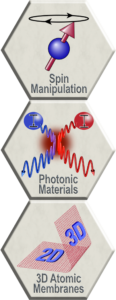
Our group is working to achieve atomic-level understanding and control of the electronic properties of interfaces, so as to better manipulate electron and spin transport. By combining advanced microscopy techniques with state-of-the-art nanofabrication and chemical synthesis, we are conducting fundamental research into the coupling between metal electrodes and molecules in single-molecule devices. We are also investigating the charge states at insulating interfaces that are used for molecular electronics, magnetic tunnel junctions, and silicon devices.
E-mail IRG leaders: Hector Abruña and Dan Ralph
Photonic Building Blocks from Multiscale Materials
IRG Senior Participants:
Alexander Gaeta (ApplPhys, co-leader), Uli Wiesner (MatSci, co-leader), Chekesha Liddell (MatSci), Michal Lipson (ElecE), Christopher Ober (MatSci), Watt Webb (ApplPhys)
Collaborators: J. Joannopoulos (MIT), R. Langer (MIT), F. Lehmann (Dyomics), S. Switalski (Kodak), R. Zentel (U. of Mainz)
Our group is working to understand and control the optical properties of a novel class of radiative nanoparticles, fluorescent core-shell silica nanoparticles (C dots), that combine the tunability of organic dyes with the durability of inorganic materials to achieve brightness levels comparable to quantum dots. The fundamental correlation between structure and photonic properties is being investigated using precise chemical control of particle size, architecture and assembly. Once synthesized, the C dots are being integrated into novel photonic devices, including waveguides and photonic crystals, with superior properties and performance to conventional approaches.
E-mail IRG leaders: Alexander Gaeta and Uli Wiesner
Dynamics of Growth of Complex Materials
IRG Senior Participants:
George Malliaras (MatSci, co-leader), David Muller (ApplPhys, co-leader), Tomás Arias (Phys), Jack Blakely (MatSci), Joel D. Brock (ApplPhys), Paulette Clancy (ChemE), James R. Engstrom (ChemE),
Collaborators: J. Anthony (U. Kentucky), D. Bowler (Univ. Coll. London), D. Dale (CHESS), R. Headrick (U. Vermont), A. Kazimirov (CHESS), H. Hwang (U. Tokyo), D. Smilgies (CHESS), Y. Suzuki (UC Berkeley), A. Woll (CHESS)
Our group aims to understand and control the dynamics of growth of complex materials and, in particular, the formation and control of the crucial interfacial layers, while fostering cross-fertilization between the organic and oxide communities. The goal is to develop the ability to fabricate heterostructures or meta-materials with the single atomic-layer precision required to achieve the ultimate in electronic device performance. We are focusing on the growth dynamics of high dielectric constant complex oxides, such as heterostructures of LaTiO3/SrTiO3, and the controlled growth of thin film organic semiconductors, such as pentacene.
Larger simulation of MgO growth
E-mail IRG leaders: George Malliaras and David Muller
Atomic Membranes as Molecular Interfaces
IRG Senior Participants:
Paul McEuen (co-leader, Phys), Jiwoong Park (co-leader, Chem), Garnet Chan (Chem), Harold Craighead (ApplPhys), Richard Hennig (MatSci), Jeevak Parpia (Phys), Keith Schwab (Phys), Michael Spencer (ElecE)
Collaborators: K. Ekinci (Boston Univ.), P. Kim (Columbia Univ.), B. Lane (Analog Devices), M. Zalalutdinov (NRL)
Our group is exploring the properties of atomic membranes: mechanically robust, freestanding films of material as thin as a single atom. The prototypical example is graphene, a single sheet of graphite. We are examining the mechanical, thermal, optical, and electronic properties of this novel material, as well as studying the effect of individual defects and adsorbates on it. In addition, we are using these membranes as an atomically thin interface between different environments, such as gas/vacuum or liquid/gas. This unprecedented ability to put different phases in nanoscale proximity, separated by only an atomically-thin wall, makes possible a wealth of new nanoscale measurements.
E-mail IRG leaders: Paul McEuen and Jiwoong Park
Seed Projects - Exploratory Research
The IRG research projects are augmented by seed projects in materials research. At present there are three seed projects in the CCMR funded through a combination of NSF and Cornell University resources.
- Bio-inspired Polymer-Reinforced Single Crystals: Synthesis, Structure and Mechanical Properties
Lara Estroff (MatSci) and Shef Baker (MatSci)
The diversity of mineralized structures formed in biology has inspired the development of synthetic routes to organic-inorganic composites with unusual morphologies and physical properties. We are developing a research program to synthesize and characterize a new class of composite materials: polymer-reinforced single crystals (PRSC’s) of calcite using a bio-inspired approach. We have recently demonstrated that crystal growth in gels is the first tractable system for systematically controlling the internal structure of calcite crystals by tuning several well-defined variables. Within this seed project our goals are (1) to understand the mechanism(s) by which organic material (e.g. fibers, proteins) is incorporated into large single crystals and learn to control the crystal growth to produce crystals with desired internal morphologies; and (2) to understand the relationships between the internal structure and mechanical properties of these composites. - Extraction of Hot or Multiple Photogenerated Charge Carriers from Semiconductor Nanocrystals
Tobias Hanrath (ChemE) and Frank Wise (ApplPhys)
Charge transfer on the nanometer scale and in inhomogeneous media is poorly-understood, despite its importance to a variety of scientific areas, and applications ranging from catalysis to optoelectronics. We are investigating the transfer of photoexcited charge from nanocrystals into nanowire conductors, with a view to processes that will be relevant to nanocrystal-based solar cells. Ultrafast spectroscopy will be coupled with electrical measurements to probe the electron- and energy-transfer mechanisms. Fundamental understanding that is developed will allow optimization of interfacial charge transfer efficiency. - Engineering Electrokinetic Activity and Anisotropy in Hydrogels
Brian Kirby (MechE), Larry Bonassar (MechE & BioE), and Lara Estroff (MatSci) - Lab-on-Fiber Biohazard Detection Systems
Antje Baeumner (BioE) and Margaret Frey (FiberSci)
To create point of use biohazard detection systems, technologies for transport, purification, concentration, capture and detection of analytes will be combined. Sensor assemblies will be formed by including molecular sensors into electrospun non-woven fabrics and fabric structure and properties will be optimized to maximize transport of analytes from liquids or moistened solid surfaces to sensing sites. Biorecognition elements incorporated into wipes or swabs will create a disposable and easy to handle method for sensing contaminants on food or medical surfaces by simply wiping the surface with the sensor assembly. - Single-Nanoparticle Catalytic Dynamics
Peng Chen (Chem), Roger Loring (Chem), and Abe Stroock (ChemE)
Nanoparticles are important catalysts, but characterization of their catalytic properties is hampered by their intrinsic heterogeneity. The goal of this project is to characterize nanoparticle catalysis at the single-nanoparticle level to overcome the heterogeneity challenge and to gain fundamental knowledge of structure-activity correlations of nanoscale catalysts. The research uses a combination of single-molecule fluorescence microscopy, theory and modeling, and microfluidics to interrogate the catalytic properties of single gold nanoparticles in ambient solution conditions.
Top :: Electronic Interfaces :: Photonic Particles :: Nanoscale Growth :: Atomic Membranes :: Seeds