
Center Research Summary
The CCMR currently supports three Interdisciplinary Research Groups (IRGs) and a number of smaller 'seed' research groups through an NSF MRSEC grant and Cornell University support. Each group brings researchers from a variety of different departments together to work on an outstanding interdisciplinary problem in materials research and development. The research teams are chosen through periodic competitions which include external review by international experts in the field. Faculty participants are drawn from the more than 100 faculty in the CCMR. These faculty span 12 departments and 4 colleges at Cornell. In addition, the research teams are strengthened by collaborations with academic and industrial researchers from around the world.
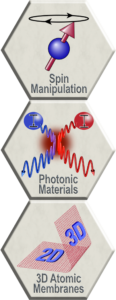
The Seed research program is devoted to the exploration of new ideas and high risk projects. Seed projects are funded for a maximum of two years. After this period, the project must transition to other support. Seed projects are not renewable.
If you have any questions about our research, please contact the IRG leaders or Seed faculty directly.
Top :: Complex Electronic Materials :: Mechanisms, Materials, and Devices for Spin Manipulation :: Atomic Membranes :: Seeds
Controlling Complex Electronic Materials
IRG Senior Participants:
Darrell Schlom (MatSci, co-leader), Kyle Shen (Phys, co-leader), Joel Brock (ApplPhys), J. C. Séamus Davis (Phys), Craig Fennie (ApplPhys), Eun-Ah Kim (Phys), Andrew Millis (Phys, Columbia Univ.), David Muller (ApplPhys)
Collaborators: R. Hennig (MatSci, Cornell), S. A. Kivelson (Stanford Univ.), M. Lawler (SUNY Binghamton), A. P. Mackenzie (St. Andrews, UK), J. Mannhart (Augsburg, Germany), P. Schiffer (Penn State), J. Schubert (Research Centre Jülich, Germany), R. Uecker (Leibniz Institute for Crystal Growth, Germany)
The theme of our research is to understand and control complex electronic materials in which quantum many-body interactions can produce spectacular electronic and magnetic properties, such as colossal magnetoresistance, giant thermoelectric power, and high-temperature superconductivity. Starting from materials that are reasonably well described by current theory, we systematically perturb the electronic structure of the targeted materials through experimentally-accessible changes in electron overlap or carrier density, then use the observed changes in materials properties to drive advances in electronic structure theory. The combination of insights from theory and experiment will allow us to optimize the physical properties we are attempting to enhance, allowing us to “close the loop” between growth, experiment, and theory. Our long-term goal is to develop a general approach to optimizing properties in a wide range of materials, including high-temperature superconductors.
E-mail IRG leaders: Darrell Schlom and Kyle Shen
Mechanisms, Materials, and Devices for Spin Manipulation
IRG Senior Participants:
Dan Ralph (Phys, co-leader), Eun-Ah Kim (Phys, co-leader), Sunil Bhave (ElecE), Robert Buhrman (ApplPhys), Craig Fennie (ApplPhys), David Muller (ApplPhys), Farhan Rana (ElecE)
Collaborators: G. Finocchio (University of Messina, Italy), I. R. Fisher (Stanford), J. A. Katine, (Hitachi Global Storage Tech.), N. P. Ong (Princeton), M. D. Stiles (NIST, Gaithersburg), J. Z. Sun (IBM, Yorktown Heights), Y. Suzuki (Osaka Univ., Japan), R. van Dover (MatSci, Cornell), A. Yazdani (Princeton)
The goal of our research is to understand, optimize, and develop applications of new methods for manipulating electron spins, in both ferromagnetic and non-ferromagnetic materials. The group is pursuing the materials innovations necessary for the control of ferromagnetic dynamics using spin-transfer torque, developing a new class of coherent, frequency-tunable microwave sources, investigating new mechanisms for current-controlled spin dynamics within antiferromagnets and ferromagnet/antiferromagnet devices, and studying spin transport and spin torque in the surface state of topological insulators. Advances in spin control may enable a variety of applications, including nonvolatile magnetic random access memories capable of being scaled to very high densities.
E-mail IRG leaders: Eun-Ah Kim and Dan Ralph
Atomic Membranes
IRG Senior Participants:
Jiwoong Park (Chem, co-leader), Michael Spencer (ElecE, co-leader), Harold Craighead (ApplPhys), Richard Hennig (MatSci), Paul McEuen (Phys), David Muller (ApplPhys), Jeevak Parpia (Phys), Farhan Rana (ElecE)
Collaborators: A. P. Alivisatos (UC Berkeley), J. C. Davis (Cornell), M. Deshmukh (TIFR, India), S. Gruner (Cornell), D. Jena (Notre Dame), G. Koley (Univ. of South Carolina), S. Krylov (Tel Aviv Univ., Israel), A. Lal (Cornell), J. Robinson (Naval Research Lab), J. Saunders, A. Casey (Royal Holloway, UK), K. Shen (Cornell), M. Sillanpaa, P. Hakonen (Helsinki Univ., Finland), G. Tompa (SMI Corp), M. Vengalattore (Cornell), A. Woll (CHESS)
Atomic membranes are a new class of two-dimensional, free-standing materials only one atom thick yet mechanically robust, chemically stable, and virtually impermeable. The prototype atomic membrane is graphene, a honeycomb lattice entirely made of carbon atoms, but other emerging systems such as the III-V boron nitride (BN) materials offer exciting new properties. Since our team reported (along with the Geim group) the first suspended atomic membranes in 2007, progress in the field has been stunning. Applications loom in almost every technological sector from electronics to chemical passivation. In particular, atomic membranes will lead to novel mechanical and window devices at a large, technologically-relevant scale, highly tunable and ultrasensitive nano-electromechanical devices for controlling and sensing nanometer scale objects, and outstanding window materials for novel x-ray and TEM studies. Our group is working to address the major materials challenges facing the realization of these applications.
E-mail IRG leaders: Michael Spencer and Jiwoong Park
Seed Projects - Exploratory Research
The IRG research projects are augmented by seed projects in materials research. At present there are three seed projects in the CCMR funded through a combination of NSF and Cornell University resources.
- Nanometer-scale patterning from templates of covalent organic frameworks
William Dichtel (Chem) and Richard Robinson (Mat Sci)
This seed is developing a new method to organize nanoparticles with unprecedented spatial and chemical control, enabling the large-scale production of nanostructured materials with properties designed and tuned for high-efficiency solar energy conversion, enhanced catalytic activity, or advanced optical applications. These materials will be built upon a covalent organic framework (COF) — a periodic material that self assembles from molecular building blocks into two- or three-dimensional structures with few-nm-size pores. In one relevant incarnation, these frameworks resemble tiny honeycombs with empty, nanometer-scale channels. Nanoparticles with controlled optical or electronic properties will be intercalated into these channels and then chemically "wired together," producing a new class of materials with spatially controlled properties. - Diamond MEMS for quantum control and sensing
Gregory Fuchs (ApplPhys), Sunil Bhave (ElecE), and John Marohn (Chem)
The introduction of single nitrogen atom into a diamond (carbon) crystal can create an atom-sized defect that may be thought of as the world's smallest magnet. Because of its small size, this magnet is exquisitely sensitive to magnetic or electric fields, to pressure (strain), and to temperature. Researchers in this Seed are developing tiny micromechanical diamond devices that will allow the quantum state of the tiny magnets to be controlled (or programmed) using mechanical motion, potentially opening the door to the realization of room-temperature quantum computers. The extreme sensitivity of these devices to magnetic fields will also enable the creation of a new class of sensors that will find application, for example, in nanoscale magnetic resonance imaging (nanoMRI). - Characterization of Ligand Passivation Strategies for Semiconductor Nanocrystal Solids
Poul B. Petersen (Chem), Tobias Hanrath (ChemE), and Frank Wise (ApplPhys)
Nanometer-scale crystals or "nanocrystals" hold great promise for solar-cell and light-emitting applications, as the optical properties of the nanocrystals (their color) can be tuned across the spectrum simply by changing the size of the crystals. The challenge lies in developing chemical reactions that efficiently and automatically “wire” the crystals together to create the high performance devices needed for practical applications. This Seed is developing new spectroscopic techniques that can monitor the transport of charge from one nanocrystal to another, thereby probing the efficiency and connectivity of the molecule-sized wires between the crystals. These techniques will enable scientists to understand and control the performance of new materials for optoelectronic applications.
Top :: Complex Electronic Materials :: Mechanisms, Materials, and Devices for Spin Manipulation :: Atomic Membranes :: Seeds